
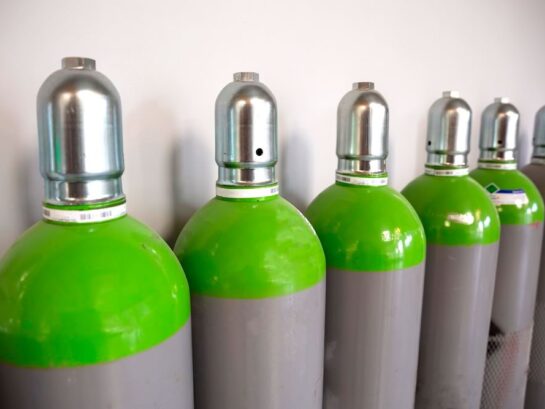
DOT hydrostatic testing is the periodic pressure test that keeps compressed gas cylinders legal to fill and safe to transport. Every cylinder used to move hazardous materials in commerce must be requalified on a schedule set by federal regulation, and a cylinder past its due date cannot be refilled until it has been tested, inspected, and marked.
For any company managing a cylinder fleet, the stakes are practical. A cylinder that fails hits the replacement budget. One that passes returns to service for another five, ten, or twelve years. A fleet out of compliance stops moving product altogether.
This article covers what DOT hydrostatic testing involves: the governing regulation, requalification intervals, how test pressure is determined, the two volumetric expansion methods, and the criteria separating a cylinder that returns to service from one condemned permanently.
Table of Contents
Key Take-a-ways
- DOT hydrostatic testing is governed by 49 CFR Part 180, Subpart C. Section 180.205 covers how testing is performed; Section 180.209 sets the intervals by cylinder specification.
- Requalification intervals run from three years to twelve, depending on the cylinder specification, the gas in service, and whether the cylinder qualifies for an extended-interval marking.
- Test pressure in DOT hydrostatic testing is fixed by specification: 5/3 of marked service pressure for most 3-series cylinders, and twice service pressure for most 4-series cylinders.
- The water jacket method and the direct expansion method both measure volumetric expansion, but only the water jacket method qualifies a cylinder for the 10 percent overfill allowance.
- A cylinder is condemned when permanent expansion exceeds 10 percent of total expansion, with a 12 percent threshold for DOT-4E aluminum cylinders and separate limits for special permit cylinders.
- Every DOT hydrostatic testing cycle must be paired with an internal and external visual inspection performed to the applicable CGA standard.
- Rejected and condemned are not interchangeable terms. A rejected cylinder may be repairable; a condemned cylinder can never return to service.
What DOT Hydrostatic Testing Is and Why the Regulation Requires It
DOT hydrostatic testing is a nondestructive volumetric expansion test. The cylinder is filled with water, pressurized well above service pressure, and measured to determine how much it stretches under load, and how much of that stretch it fails to recover once pressure is released.
The unrecovered portion is the point of the test. A sound cylinder behaves elastically, returning to its original volume after pressure is released. A cylinder whose wall has thinned through corrosion, or whose metallurgy has degraded, does not. That residual difference, called permanent expansion, measures structural degradation no visual inspection alone can detect.
The requirement lives in 49 CFR Part 180, Subpart C, which governs qualification, maintenance, and use of cylinders. Two sections do most of the work. Section 180.205 establishes the general framework: test methods, inspection obligations, and the criteria for rejection and condemnation. Section 180.209 holds the table setting minimum test pressure and requalification interval for each specification.
How Often DOT Hydrostatic Testing Is Required
How often DOT hydrostatic testing must be repeated is driven by cylinder specification first, then modified by the gas in service and by the cylinder's markings.
| Specification | Minimum test pressure | Interval (years) | Governing conditions |
| DOT-3 | 3,000 psig | 5 | §180.209(a) |
| DOT-3A, 3AA | 5/3 × service pressure | 5, 10, or 12 | Star extension; poisonous materials; anhydrous ammonia; fire extinguisher use |
| DOT-3AL | 5/3 × service pressure | 5 or 12 | 6351-T6 alloy requires eddy current inspection |
| DOT-3AX, 3AAX | 5/3 × service pressure | 5 | §180.209(a) |
| DOT-3B, 3BN | 2 × service pressure | 5 or 10 | Non-corrosive service |
| DOT-3E | Test not required | — | Exempt |
| DOT-3HT | 5/3 × service pressure | 3 | Condemned at 24 years or 4,380 pressurizations |
| DOT-4AA480 | 2 × service pressure | 5 or 10 | §180.209(g), (h) |
| DOT-4B, 4BA, 4BW | 2 × service pressure | 5, 7, 10, or 12 | §180.209(e), (f), (j) |
| DOT-4D, 4DA, 4DS | 2 × service pressure | 5 | §180.209(a) |
| DOT-4E | 2 × service pressure | 5, 10, or 12 | 12% permanent expansion threshold |
| DOT-4L | Test not required | — | Exempt |
| DOT-8, 8AL (acetylene) | Visual / porous filler | 10 or 20 | Per CGA C-13 schedule |
| Special permit cylinder | Per permit | Per permit | Per individual permit |
The most misunderstood provision is the star marking. A DOT-3A or 3AA cylinder of 125 pounds water capacity or less may carry a five-pointed star stamped after its test date, extending the interval from five years to ten. Qualifying is conditional: the cylinder must be removed from any cluster or rack each time it is filled, used exclusively for a defined list of non-corrosive gases such as air, argon, helium, nitrogen, and oxygen, and dried immediately after testing. Fill a starred cylinder with a gas outside that list and the star must be obliterated, reverting it to a five-year cycle.
Two specifications are exempt from periodic testing entirely: DOT-3E and DOT-4L. Size buys an exemption as well, a cylinder measuring no more than two inches across and standing under two feet tall skips the volumetric expansion test.
DOT-3HT cylinders sit at the opposite end of the range. They require testing every three years and are condemned outright at 24 years from manufacture or 4,380 pressurizations, whichever comes first. Composite cylinders follow their own special permit terms rather than the table above, under PHMSA's DOT-CFFC basic requirements.
How Test Pressure for DOT Hydrostatic Testing Is Determined
Test pressure is fixed by specification rather than calculated job by job. For most 3-series cylinders it is 5/3, roughly 1.667 times, the marked service pressure. Most 4-series cylinders are tested at twice service pressure.
Worked from that 5/3 ratio, common service pressures produce the following test pressures:
| Marked service pressure (psig) | Test pressure at 5/3 (psig) |
| 2,015 | ≈ 3,358 |
| 2,216 | ≈ 3,693 |
| 2,265 | ≈ 3,775 |
| 3,000 | 5,000 |
| 4,500 | 7,500 |
This is a separate regime from process piping, and the two are often conflated. ASME B31.3 requires hydrostatic test pressure of at least 1.5 times design pressure at every point in a metallic piping system, a rule written for fixed installations, not transportable cylinders. Applying one multiplier in place of the other satisfies neither standard. Our overview of proof pressure testing covers the piping side in more detail.
The Two DOT Hydrostatic Testing Methods
Both methods are prescribed in CGA C-1, Methods for Pressure Testing Compressed Gas Cylinders, which federal regulation incorporates by reference.
Water Jacket Method
This is the most widely used approach to DOT hydrostatic testing. The cylinder is filled with water and sealed inside a water-filled test jacket. As it is pressurized it expands, displacing water from the jacket into a calibrated glass tube that measures total expansion. When pressure is released the cylinder contracts and draws water back. Whatever it fails to draw back is permanent expansion.
The water jacket method carries one regulatory advantage: only cylinders tested this way qualify for the 10 percent overfill allowance, meaning they may be filled to 110 percent of marked service pressure. Direct expansion does not confer that permission.
Direct Expansion Method
A measured volume of water is forced into the cylinder to bring it to test pressure. On depressurization, the volume expelled is measured against the volume forced in and corrected for the compressibility of water, which yields total expansion.
Direct expansion avoids the infrastructure a test jacket requires, making it practical for oversized vessels and for DOT hydrostatic testing outside a fixed shop. The regulation treats both methods as co-equal for most specifications.
Proof Pressure Testing
A third method under CGA C-1 measures no expansion at all. The cylinder is examined under pressure and rejected if a leak or visible defect appears. It substitutes for volumetric methods in specific cases, though often on a shorter cycle: large fire extinguisher cylinders receive twelve years on a volumetric method versus seven on proof pressure.
Reading Permanent Expansion: Pass, Reject, or Condemn
The regulation's definition is spare: whatever volume a cylinder gains and then keeps once the pressure comes off. Expressed as a percentage of total expansion, that figure is the primary acceptance metric in DOT hydrostatic testing.
- The 10 percent rule. A DOT specification cylinder is condemned when permanent expansion exceeds 10 percent of total expansion. That figure is widely quoted as though it were universal. It is not. DOT-4E aluminum cylinders are held to 12 percent, and special permit cylinders follow the limits stated in their individual permits.
- Rejection Elastic Expansion. DOT-3HT cylinders carry a second, independent criterion. Stamped on the cylinder in cubic centimeters, the REE figure sits five percent above the elastic expansion the cylinder recorded when it was built, a benchmark set in 49 CFR 178.44. Exceed that stamped number on test and the cylinder is condemned. Where the 10 percent rule measures plastic deformation, REE measures whether the high-strength steel has lost temper. A cylinder can pass one criterion and fail the other.
- Other condemnation triggers include leakage through the wall, cracking severe enough to weaken the cylinder appreciably, evident overpressurization, expired service life, improper sidewall stamping, and, for aluminum and aluminum-lined composite cylinders, evidence of overheating — with arc burns treated as proof of it.
- Rejected is not condemned. A rejected cylinder may be repairable and returned to service. A condemned cylinder never returns by any means: it is stamped, labeled, or rendered incapable of holding pressure, and the owner must be notified in writing.
Visual Inspection Runs Alongside Every Test
DOT hydrostatic testing is never performed in isolation. Pressurizing a cylinder obligates the requalifier to examine it inside and out during the same cycle. The governing standard depends on construction: CGA C-6 for steel and nickel, C-6.1 for seamless aluminum, C-6.2 for fiber-reinforced composite, C-6.3 for low-pressure aluminum, C-8 for DOT-3HT, and C-13 for acetylene.
The numeric pass-fail thresholds for corrosion depth, dents, gouges, and bulges live inside those CGA pamphlets rather than the regulation itself, which is why DOT hydrostatic testing and visual inspection are treated as a single qualification event. Coatings or attachments obstructing inspection must be removed first.
Some conditions require requalification regardless of where a cylinder sits in its cycle. Fire damage, arc burns, and thermal damage all trigger testing before further use. DOT-3AL cylinders in 6351-T6 aluminum used for breathing air or oxygen service also require eddy current examination.
How CGA Standards Relate to DOT Requirements
This relationship is described incorrectly with some regularity, including by testing vendors who present CGA methods as an option alongside DOT hydrostatic testing. CGA pamphlets are not an alternative to DOT compliance, and they are not a competing regime to choose between.
Federal regulation incorporates the CGA documents governing DOT hydrostatic testing by reference at 49 CFR 171.7, which lists each pamphlet, its edition, and the sections into which it is incorporated. That text then carries the same legal force as if printed in the regulation directly. When the regulation directs a requalifier to test in accordance with CGA C-1, following C-1 is not an alternative to compliance. It is compliance. PHMSA maintains the authoritative guidance for cylinder requalifiers covering how that framework is administered.
Cylinders bearing UN or metric markings follow a parallel track under Section 180.207, which keys its procedures to ISO standards: ISO 6406 for seamless steel, ISO 10461 for seamless aluminum, and ISO 11623 for composite cylinders. A cylinder is governed by one regime or the other according to its markings, never both.
Cleanliness, Drying, and Test Water Quality
DOT hydrostatic testing introduces water into a cylinder that will go back into gas service, which makes what happens after the test as consequential as the test itself.
The regulation makes drying explicit in one place: star-marked cylinders qualify for their extended interval only if dried immediately after testing to remove all traces of water. More broadly, CGA C-1 and ISO 11623 both treat draining and drying as standard post-test operations, and internal visual inspection is sequenced before the pressure test so contaminated cylinders are cleaned first.
Water quality matters for the test medium itself. The regulation sets no numeric chloride limit, but corrosion engineering practice commonly holds austenitic stainless steel to roughly 50 ppm chloride, tightened to 25 ppm under some specifications, to avoid chloride-induced stress corrosion cracking.
Cylinders returning to oxygen service carry a further requirement. Cleaning for oxygen and oxidizer service follows CGA G-4.1, which applies to any surface contacting gas at an oxygen concentration above 23.5 percent, the standard behind oxygen cleaning services. High-purity cleaning requirements for semiconductor and electronics-grade cylinders are customer specifications layered on top of the DOT requirement, not embedded within it.
Choosing a DOT Hydrostatic Testing Partner
DOT hydrostatic testing is a compliance function, not simply a shop process. The test has to be right, the inspection documented, and the cylinder returned ready for the gas it will carry. For most fleet owners that combination is more efficiently outsourced than built in-house.
Precision Fabricating & Cleaning has spent nearly six decades testing pressurized components for customers in aerospace, industrial gas, chemical processing, and power generation.
PFC performs hydrostatic and pneumatic testing at pressures up to 30,000 psi, using Sprague air-driven pumps with ratios from 10:1 to 100:1 to deliver the high-pressure liquid volumetric expansion testing requires, and works to CGA, ISO, ASME, ASTM, and SAE standards.
What sets PFC apart in DOT hydrostatic testing is that testing and precision cleaning happen under one roof. A cylinder headed back into oxygen service needs cleaning to CGA G-4.1. One in high-purity or semiconductor gas service needs cleanliness verification the DOT regulation never addresses. Every cylinder just filled with water needs thorough drying. Most testing houses send that work out; PFC does it in the same facility, removing a handoff, a shipping leg, and a point of failure from your schedule.
If you are evaluating outside support for cylinder testing and cleaning, PFC can walk you through what your fleet requires.
Start a conversation with PFC about your proof testing needs right here.