
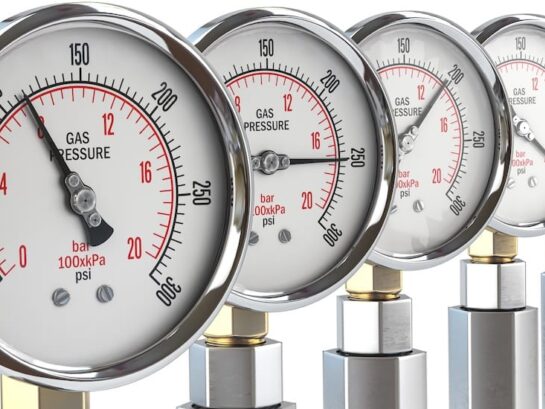
Pressure gauge selection is one of those decisions that seems straightforward until something goes wrong. When a gauge is poorly matched to its application, the consequences rarely show up immediately. Instead, they compound quietly: inaccurate readings lead to bad process decisions, premature corrosion shortens gauge life, and calibration reports start flagging issues that could have been avoided from the start.
The result? Unplanned downtime, wasted money, and in some cases, genuine safety risk.
In this article, we’re not walking through a step-by-step gauge selection checklist. We’ve covered that in a previous post. Instead, we’re looking at what actually happens when pressure gauge selection goes wrong, why those failures cost more than most people realize, and what to do about it.
Table of Contents
Key Takeaways
Good catch for SEO. Here's the revised set:
- Poor pressure gauge selection creates hidden costs through accuracy drift, premature corrosion, and shortened service life. A gauge that "works" isn't the same as one that's right for the job.
- ASME B40.100 recommends keeping normal operating pressure within 25–75% of the gauge's full-scale range, and no higher than 50% when pulsation is present.
- Accuracy is only one piece of the pressure gauge selection puzzle: case material, wetted parts, dial size, connection type, and environmental conditions all determine whether a gauge actually performs to its rated spec.
- Lower accuracy grades (A through D) allow wider error margins in the upper and lower 25% of the range, so your effective accuracy may be worse than the headline number suggests.
- If your gauge's tolerance is wider than the equipment it's monitoring (like a relief valve's set-pressure window), the measurement is meaningless, that's a selection failure, not a calibration failure.
- Environmental factors like temperature swings, moisture, vibration, and corrosive fumes can degrade gauge performance from the outside in, making sealed cases and liquid fill essential in harsh installations.
- Even the best pressure gauge selection can't replace regular calibration, cleaning, and maintenance, partnering with a specialized service provider like PFC helps protect your investment over the long term.
The Real Cost of a Mismatched Pressure Gauge
A pressure gauge that technically “works” isn’t the same as one that’s right for the job. Gauge failures rarely announce themselves with a dramatic blowout. More often, they show up as slow accuracy drift, readings that gradually move outside acceptable tolerance, or internal corrosion that eats away at the Bourdon tube over months.
Here are a few scenarios that illustrate how poor selection creates hidden costs:
Accuracy Overkill or Underspec
A facility installs a gauge with 2.0% accuracy on a critical process that requires 0.5%. Every reading is technically within the gauge’s rated tolerance, but it’s not precise enough for the application. Operators make process adjustments based on imprecise data, leading to product quality issues that are difficult to trace back to instrumentation.
The flip side is just as wasteful: installing a 0.25% laboratory-grade gauge on a general industrial line where 1.0% would have been perfectly adequate. That’s budget spent on precision nobody needs.
Wrong Wetted Parts for the Process Media
The Bourdon tube and socket are the components in direct contact with the process fluid. When these wetted parts aren’t compatible with the media, say, a brass socket exposed to a mildly corrosive chemical, the result is gradual corrosion that degrades accuracy long before the gauge visibly fails.
Eventually the gauge needs replacement, but the bigger cost is the period of unreliable readings that went undetected.
Operating Outside the Recommended Pressure Range
ASME B40.100 recommends that normal operating pressure stay within 25–75% of the gauge’s full-scale range, and no higher than 50% of full scale when pulsation is present. A gauge routinely operated at 90% of its range is being overstressed. The Bourdon tube loses elasticity, the pointer drifts, and calibration intervals have to be shortened.
All of that costs time and money that proper range selection would have prevented.
Why Gauge Accuracy Is Only Part of the Pressure Gauge Selection Equation
Accuracy gets the most attention in gauge selection, and for good reason, as it directly affects measurement reliability. For a mechanical pressure gauge, accuracy is defined as a percentage of the full-scale range. In most industrial and commercial applications, gauges typically range from ±0.25% to ±2.5% accuracy, and the right choice depends on the application:
- 0.25% or better – test gauges and standards
- 0.5% – critical processes
- 1.0% – general industrial use
- 2.0% – less critical commercial applications
But accuracy doesn’t exist in a vacuum. A gauge rated at ±0.5% can drift well beyond that tolerance if other selection factors are ignored.
Temperature and accuracy: Many manufacturers specify that for every 18°F (10°C) shift in ambient temperature from the calibration baseline, a Bourdon tube gauge can introduce up to ±0.4% additional error of full scale. That means a 0.5% gauge operating 36°F outside its calibration temperature could effectively perform like a 1.3% gauge.
Dial size matters too. Gauges with accuracy ratings of 0.25% or 0.5% generally require dial sizes of 4-1/2 inches or larger because the finer graduations needed for high-accuracy readings simply won’t fit on a smaller dial. Specifying a high-accuracy gauge with a small dial defeats the purpose of the precision you’re paying for.
The broader point: accuracy is the specification that gets written into purchase orders, but it’s maintained, or eroded, by everything else. Case material, connection type, operating range, and environmental conditions all play a role. Getting the accuracy grade right while getting these other factors wrong is a common and costly mistake.
What Calibration Reports Reveal About Pressure Gauge Selection Mistakes
Calibration reports are the clearest window into whether a gauge is performing to spec, and they often reveal selection problems that weren’t obvious at installation.
Understanding accuracy grades. The ASME/ANSI grading system classifies gauges from Grade 4A (laboratory precision, ±0.1% across the entire range) down through Grades 3A, 2A, 1A, A, B, C, and D. The higher grades maintain uniform tolerance across the entire span. But the lower grades, the ones most common in industrial settings, allow wider error bands in the lower and upper 25% of the range, with tighter tolerance only in the middle 50%.
This is a critical detail many operators miss. A Grade A industrial gauge is rated at 1% of span in the middle half of its range, but 2% at the extremes. If your normal operating pressure falls in that lower or upper quarter, you’re getting half the accuracy you might assume from the headline specification.
Real-World Example: When Gauge Tolerance Exceeds Equipment Tolerance
A pressure gauge with a 0–10,000 psi range and 1.0% full-span accuracy has a tolerance of ±100 psi across the scale.
That gauge is used to verify a relief valve with a set pressure of 300 psi and a set-pressure tolerance of ±3%, a window of just 291–309 psi.
The gauge’s ±100 psi tolerance is far wider than the 18 psi verification window. The gauge physically cannot confirm whether the valve is within spec. This isn’t a calibration failure, it’s a selection failure.
Environmental Factors That Undermine Gauge Performance
Even a perfectly specified gauge can fail prematurely if the installation environment isn’t accounted for. Environmental considerations include ambient temperature, airborne particulate, condensation, humidity, water exposure, and chemical fumes, all of which degrade performance from the outside in.
Temperature
Beyond the accuracy effects described above, extreme ambient temperatures can damage the case, lens, and fill fluid in liquid-filled gauges. When conditions routinely push beyond the gauge’s rated temperature range, specifying a temperature-compensated gauge or isolating the gauge from the heat source is far more cost-effective than replacing failed gauges repeatedly.
Moisture, Corrosion, and Particulate
Gauges in high-humidity environments, wash-down areas, or locations with corrosive fumes need to be weatherproof or hermetically sealed. Liquid-filled gauges serve double duty: the fill fluid (typically glycerin or silicone) dampens pointer vibration and keeps moisture and particulate out of the mechanism.
A standard dry gauge installed in a wash-down area is going to fail. It’s not a question of if, but when, and the interim period of unreliable readings is the hidden cost.
Vibration and Pulsation
Mechanical vibration from nearby equipment and pressure pulsation from pumps or compressors are two of the most common causes of premature gauge failure. Vibration fatigues the pointer mechanism and internal linkage; pulsation repeatedly stresses the Bourdon tube beyond its intended duty cycle.
Liquid-filled cases dampen both effects. Pairing that with a pressure range where normal operation stays at or below 50% of full scale, per ASME B40.100, gives the Bourdon tube enough headroom to handle the peaks.
Connection and Mounting: The Details That Matter
Connection size and location don’t typically cause catastrophic failures, but they contribute to chronic, low-grade problems that drive up maintenance costs over time.
Gauges are available with a variety of connection standards: NPT, DIN, JIS, BSP, and SAE. Process gauges with 4-1/2 inch or larger dials are most commonly supplied with a 1/2 inch NPT connection, which provides the mechanical support the gauge’s weight requires. Key factors to consider:
- Process pressures and leak integrity
- Gauge size and weight relative to the connection
- Space limitations at the installation point
- Mounting style (stem mount, wall mount, panel mount, U-clamp, or front flange)
The wrong choices here mean gauges that leak, gauges that can’t be read from the operator’s normal position, and gauges that have to be removed and reinstalled every time they need calibration. Over the life of the gauge, those inefficiencies add up.
How to Avoid Costly Pressure Gauge Selection Errors
The common thread in all of these failure modes is that they’re preventable. Most selection mistakes come from focusing on one specification, usually accuracy or price, while overlooking the application context. Before specifying a gauge, work through these critical questions:
- What’s the actual operating pressure and full-scale range? Your normal operating point should sit in the middle 50%. If pulsation is present, keep max operating pressure at or below 50% of full scale.
- What accuracy do you actually need? Remember that the headline number only applies in the middle of the range for lower-grade gauges. If your operating point is in the lower or upper quarter, your effective accuracy is worse than the spec suggests.
- Is the gauge tolerance narrower than the equipment it’s monitoring? If you’re verifying a relief valve or safety device, the gauge’s tolerance must be significantly tighter than the device’s set-pressure tolerance. If it isn’t, the measurement is meaningless.
- Are the wetted parts compatible with the process media? If there’s any doubt, consider a diaphragm seal to isolate the gauge from the process fluid.
- What are the environmental conditions at the installation point? Temperature extremes, humidity, washdowns, corrosive atmospheres, vibration, and particulate all influence whether you need a sealed case, liquid fill, temperature compensation, or a combination.
- Will the connection and mounting support the gauge and allow easy maintenance? Ensure the connection size is appropriate for the gauge’s weight, and choose a mounting style that keeps the dial readable and accessible for calibration.
Precision Fabricating & Cleaning: Your Partner in Pressure Gauge Performance
Proper pressure gauge selection doesn’t end at the purchase order. Even well-chosen gauges need regular calibration, cleaning, and maintenance to continue performing at their rated specifications. Environmental contamination, process media residue, and normal mechanical wear all take their toll, and without a disciplined maintenance program, even the best gauge will drift out of tolerance.
That’s where Precision Fabricating & Cleaning comes in. As a specialized outsourced gauge cleaning and testing partner, PFC provides the expertise and infrastructure to keep your pressure gauges performing reliably throughout their service life. Our services are built around the specific demands of pressurized systems, from process vessels to testing environments, with strict attention to cleanliness standards and traceability.
Whether you’re dealing with gauges that have drifted out of spec, gauges contaminated by process media, or you simply need a reliable calibration program to prevent the kinds of failures described in this article, PFC has the capabilities to support you. Our team understands that gauge performance is only as good as the maintenance behind it, and we treat every gauge with the precision your operations demand.
Don’t let poor gauge maintenance undermine good gauge selection. Contact Precision Fabricating & Cleaning today to learn how our outsourced gauge cleaning and testing services can protect your investment and keep your operations running safely.